
Textile & Interior Design Trends 2027–2028: What They Mean for Rug Buyers
Why 2027 Is a Turning Point for Interior Textiles
The design landscape is shifting in ways that matter practically for anyone sourcing textiles — and rugs in particular. After years dominated by clean minimalism and algorithmic aesthetics, the most compelling interiors of 2027–2028 are moving toward the human, the organic and the historically resonant. Five distinct trends are driving this shift. Each one carries specific implications for how designers, retailers and contract specifiers should be thinking about their rug sourcing decisions.
1. The Hand as Signature
Perhaps the most significant shift of the moment: visible craftsmanship is no longer something to minimise. It has become the point.
Materials with irregular dyeing, visible knots, asymmetrical finishes and the unmistakable trace of a human hand are taking centre stage across the most forward-thinking interior collections. The reasoning is cultural as much as aesthetic — in a world increasingly saturated with AI-generated perfection, the deliberate imperfection of artisan work carries a meaning and a value that no machine can replicate. For the rug market, this translates directly into a renewed appetite for pieces where the making is visible. Carving that reads at surface level. Pile that holds the memory of the artisan’s gesture. Colour fields that shift subtly because no two dye batches are identical. This is not a trend that rewards industrial production. It rewards manufacturers with a
genuine craft culture — the kind built over decades, not rebranded overnight. What to look for when sourcing: visible surface carving, hand-applied finishing, yarn compositions that carry natural variation, and manufacturers who can document and communicate their process authentically.
2. Marine Biophilic
The biophilic trend — the integration of natural forms and references into interior environments — is maturing. Where earlier iterations drew broadly from nature (botanicals, wood grain, organic silhouettes), the 2027–2028 direction is becoming more specific and more complex: the underwater world.
Biomorphic forms inspired by coral, lichen, sediment and the sculptural quality of marine organisms are emerging as a coherent aesthetic language. This is no longer metaphorical nature — it is formally precise, architecturally considered, and applied to surfaces including walls, furniture and floors. On the floor, this translates into sculpted organic shapes, textured surfaces that evoke depth and geological layering, and palette references drawn from coastal and
underwater environments: deep teals, mineral blues, sandy neutrals, weathered corals. For rug specifiers, the marine biophilic trend is an opportunity to move beyond the flat and the rectilinear — toward shaped rugs, heavily textured surfaces and colour
stories that read as found rather than designed. What to look for when sourcing: manufacturers with experience in shaped (nonrectangular) formats, high-low pile construction that creates genuine surface relief, and colour capabilities in the blue-green-mineral range.
3. Grounding
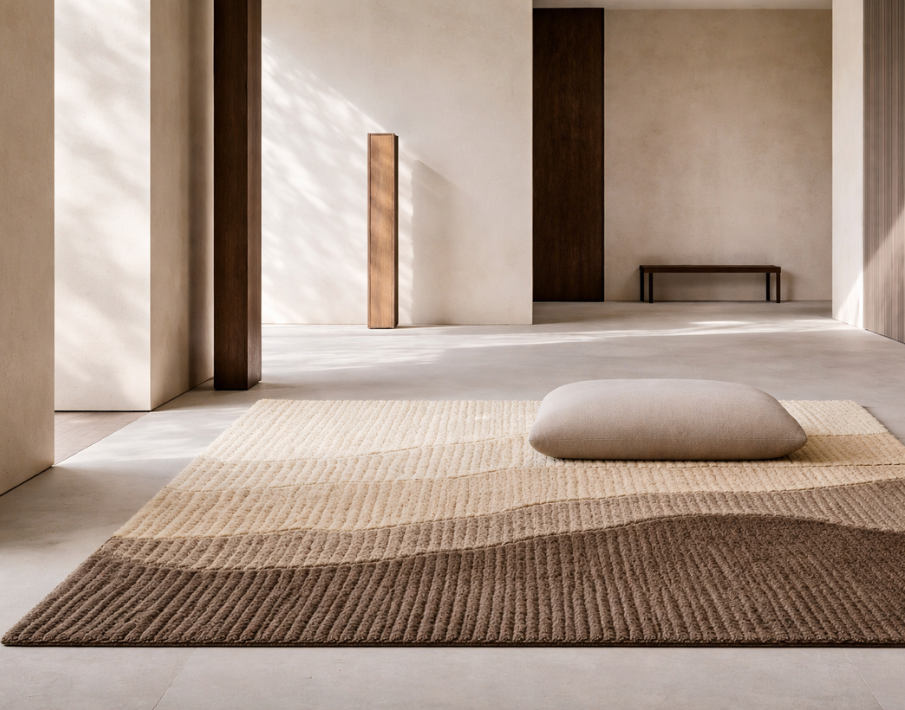
A subtler but equally powerful shift is taking place in the overall emotional register of interiors. After years of spaces designed to impress, perform and signal, the dominant mood of 2027–2028 interiors is one of stability and recovery. This translates into a palette anchored in warm neutrals — rich browns, soft pastels, muted sands — with carefully placed accent tones: sage green, deep terracotta, mineral blue. The emphasis is on materials that feel durable and enduring, objects that have a sense of permanence rather than seasonality. For rugs, Grounding means pieces designed to anchor a room rather than animate it. Warm neutral palettes. Wool constructions that improve with age. Proportions and weights that feel considered and settled. These are not statement rugs — they are foundation rugs, and they require a manufacturer who understands the difference. This trend also aligns strongly with a growing client demand for provenance and longevity — the shift away from fast interior towards pieces acquired once and kept for years.
What to look for when sourcing:
wool-dominant constructions, warm neutral colourways with depth, classic proportions, and manufacturers who can speak to the durability and ageing characteristics of their materials.
4. Decorative Detail
At a moment when functionality and optimisation dominate much of the design conversation, an important countermovement is gaining ground: the deliberate return of decorative detail. This is not maximalism — it is more precise than that. A ruffle on an otherwise minimal curtain. A carefully placed relief on a neutral ground. A surface interruption that makes you pause and look more closely. The logic is that in rooms stripped to their structural essentials, a single decorative gesture carries far more weight than it would in a busier environment. For rugs, this trend speaks directly to the expressive potential of relief and pile variation. High-low construction — where different pile heights create a threedimensional surface reading — becomes a vehicle for precisely this kind of deliberate interruption. Retro carving techniques, where the pile is sculpted after tufting to define motifs and edges, are particularly well positioned. The buyer implication is significant: rather than needing an entire pattern story, a well-executed textural detail on a neutral ground can carry the brief entirely. What to look for when sourcing: manufacturers with skilled carving capability, high-low pile construction expertise, and the design sensibility to execute detail work with restraint rather than excess.
5. Revisited Baroque
The fifth trend is the most historically charged — and the one that requires the most careful handling in a sourcing context. Revisited Baroque draws on the drama, ornamental richness and expressive volume of historical European aesthetics — but filters them through a contemporary lens that prevents the result from reading as pastiche. The goal is not reproduction but reinterpretation: motifs with historical resonance, rendered with materials and
proportions suited to today’s interiors. In practical terms, this means bold pattern work — scrolling forms, dense ornamentation, high-contrast palette combinations — executed with enough restraint in scale and material to read as current. Burgundy, deep plum, ivory and gold remain relevant, but the execution must feel considered rather than theatrical. For rug specifiers, Revisited Baroque is an opportunity to work with manufacturers capable of genuine pattern complexity — the kind of dense, intricate design work that separates a true craft operation from a simplified production facility. It also rewards manufacturers who understand historical textile references and can translate them with intelligence rather than literalism. What to look for when sourcing: manufacturers with strong in-house design capability, experience with complex pattern execution, and a portfolio that demonstrates range — from the minimal to the ornate.
Reading the Five Trends Together
Taken as a whole, the 2027–2028 textile landscape rewards authenticity, craft depth and manufacturing intelligence. The five trends — Hand Signature, Marine Biophilic, Grounding, Decorative Detail, Revisited Baroque — converge around a common
logic: interiors are moving toward the meaningful, the enduring and the human. For buyers, this creates both an opportunity and a challenge.
The opportunity: clients and end consumers are increasingly ready to invest in pieces with genuine provenance and craft quality.
The challenge: delivering on that promise requires a manufacturing partner who can actually back it up — with process transparency, material expertise and creative capability that goes beyond a catalogue.
Sourcing for 2027: Choosing the Right Manufacturing Partner
Trend awareness is only useful when it informs sourcing decisions. The question for any buyer reading this is not simply what the trends are — it is who can deliver on them.
Look for a manufacturer who can demonstrate:
● A documented, transparent production process rooted in genuine craft
● Material knowledge deep enough to guide your brief, not just execute it
● Design capability that spans the minimal and the complex
● Sustainable dyeing and production practices aligned with your clients’ expectations
● A portfolio that shows range across texture, palette and form The trends of 2027–2028 are not a brief for any single aesthetic. They are a brief for quality, depth and the kind of manufacturing partnership that holds up over time.
Rugs & Riches: Craft-Led Manufacturing for a Changing Market
Based in Panipat, India, Rugs & Riches has spent over 35 years building the kind of craft depth that the 2027–2028 market is looking for. From visible hand-carving to artist collaborations, from sustainable dyeing practices to custom pile construction — every capability on a design-led buyer’s sourcing checklist. If you’re building a collection for the coming seasons, we’d welcome a conversation about what’s possible.
Perfect mirror for you