

Sustainable Rug Manufacturing in India:What Responsible Sourcing ActuallyLooks Like
Sustainability in the Rug Industry: From Checkbox to Competitive Advantage
For buyers sourcing rugs from India, sustainability has moved well beyond a nice-tohave. European retailers face tightening due diligence regulations. Interior designers working on LEED or BREEAM-certified projects need to document material provenance. Brands with public ESG commitments require supply chain transparency that holds up to scrutiny. The challenge is that “sustainable” has become one of the most overused — and least defined — terms in the sourcing vocabulary. A manufacturer can claim it with a single recycled yarn line and no further evidence. The question that matters for a
serious buyer is not whether a supplier uses the word, but what they can actually demonstrate. This article sets out what responsible rug manufacturing concretely looks like — across materials, dyeing, production practices and social standards — and what questions to ask before committing to a sourcing relationship.
The Environmental Footprint of a Rug: Where It Actually Comes From
To assess a manufacturer’s sustainability credentials meaningfully, it helps to understand where the environmental impact of a hand-tufted rug is concentrated.
Three areas dominate:
Dyeing and water use — Textile dyeing is one of the most water-intensive and potentially polluting processes in manufacturing. Conventional synthetic dyes can release heavy metals and toxic compounds into water systems if not properly managed. The dyehouse is the single most important environmental variable in a rug’s production.
Raw material sourcing — Wool is a natural, renewable and biodegradable fibre — significant advantages over synthetic alternatives. But its environmental profile depends on how and where the animals are raised, and how the raw fibre is processed before it reaches the manufacturer. Knowing the yarn supply chain matters.
Chemical finishing — Backing adhesives, anti-moth treatments and stainresistance finishes can all introduce chemical compounds that affect both
environmental and indoor air quality standards. A rug destined for a residential or contract interior should be free of harmful substances — and that claim should be verifiable.
he dyehouse is where the sustainability story of a rug is largely written — and where the gap between manufacturers is most significant.
Responsible dyeing practices include:
AZO-free dyes — AZO compounds, used in some conventional synthetic dyes, can break down into aromatic amines linked to health concerns. AZO-free formulations are the baseline requirement for any manufacturer supplying to the European
market, where REACH regulations set strict limits on restricted substances.
Low-impact dye formulations — Beyond AZO compliance, truly responsible dyeing
uses formulations designed to minimise water consumption, require lower
processing temperatures and generate less effluent.
These are measurable parameters — a serious manufacturer should be able to speak to them.
Closed-loop water management — In responsible dyehouses, water used in the dyeing process is treated and recycled rather than discharged into local water systems. This is both an environmental and a community responsibility, particularly in regions where water access is a local concern.
Colour accuracy and batch consistency — This is often overlooked in sustainability discussions, but it matters: precise colour matching reduces the number of correction batches required, which directly reduces water and dye consumption. A skilled dye master is not just a quality asset — they are an efficiency asset.
Wool: The Material Case for Natural Fibres
In the context of a growing industry-wide conversation about synthetic material alternatives, wool’s environmental credentials deserve closer examination.
Wool is naturally renewable — it grows back every year. It is biodegradable at end of life, breaking down in soil rather than accumulating as microplastic waste, which is the documented consequence of synthetic pile fibres. It is naturally resilient and selfrepairing at a fibre level, which translates into a longer functional lifespan for the finished rug — reducing the replacement cycle that drives much of the textile industry’s environmental footprint.
For contract and high-end residential applications, the longevity argument is particularly compelling. A wool rug manufactured to a high standard and properly maintained can last decades. The environmental cost of production, amortised over that lifespan, compares very favourably to synthetic alternatives replaced every five to seven years. The caveat is supply chain visibility. Responsible wool sourcing means being able to trace the fibre back to its origin — ideally with documentation of animal welfare and land management standards. This is an area where manufacturers who have built long-term relationships with their yarn suppliers are significantly better positioned than those working through intermediaries.
Social Responsibility: The Human Side of Sustainable Sourcing
Environmental credentials are only one dimension of responsible sourcing. The social dimension — labour conditions, fair wages, safe working environments — is equally important, and increasingly subject to regulatory scrutiny. The EU’s Corporate Sustainability Due Diligence Directive (CSDDD), phasing in from 2026, requires larger European companies to conduct due diligence on human rights and environmental impacts across their supply chains. For buyers sourcing from India, this means the question of labour conditions is no longer optional to address.
What responsible labour practices look like in an Indian rug manufacturing context:
Documented employment and fair wages — Workers should be formally employed with documented contracts and wages that meet or exceed local legal standards. In the context of Indian manufacturing, this is not universal — it is a differentiator.
Safe working conditions — The tufting environment involves tufting guns, yarn dust and repetitive physical work. Proper ventilation, protective equipment and ergonomic workstation design are markers of a manufacturer who takes worker welfare seriously.
No child labour — GoodWeave certification is the most recognised third-party standard for child labour-free rug production. Even without formal certification, a manufacturer should be able to demonstrate their workforce composition and recruitment practices transparently.
Community investment — The most credible manufacturers in the Indian rug industry have moved beyond compliance toward genuine community integration — supporting local schools, providing healthcare access, or offering skills training that creates long-term opportunity for workers and their families.
Certifications: What They Mean and What They Don't
Third-party certifications provide a layer of independently verified assurance — but they are not a complete picture on their own.
OEKO-TEX Standard 100 — Tests finished textiles for harmful substances. A strong baseline requirement for any product entering the European or US market. Confirms the finished rug is free from a defined list of chemicals at harmful concentrations.
GoodWeave — Specifically addresses child labour and forced labour in the rug supply chain. Involves unannounced factory inspections. The most directly relevant certification for social compliance in rug manufacturing.
ISO 14001 — Environmental management system standard. Indicates a manufacturer has structured processes for managing their environmental impact — but does not certify specific outcomes.
GOTS (Global Organic Textile Standard) — Relevant for wool sourcing if organic fibre claims are made. Covers both environmental and social criteria across the supply chain. The practical point for buyers: certifications are a starting point, not an endpoint. A manufacturer with no certifications but complete process transparency and documented practices may offer more genuine assurance than one with a certification wall and no ability to answer specific questions.
The Buyer's Sustainability Checklist
Before qualifying a rug manufacturer on sustainability grounds, these are the
questions that cut through the language:
● What dye formulations do you use, and are they AZO-free and REACHcompliant?
● How is your dyehouse water managed — is there a treatment and recycling
system in place?
● Where does your wool come from, and how far back can you trace the supply chain?
● What certifications do you hold, and when were they last audited?
● Can you provide documentation of your employment practices and wage levels?
● How many people work in your facility, and what does their employment
relationship look like?
● Are factory visits possible — or can you provide documented evidence of
production conditions?
A manufacturer who can answer these questions precisely and without hesitation has done the work. One who responds with generic language and marketing material has not.
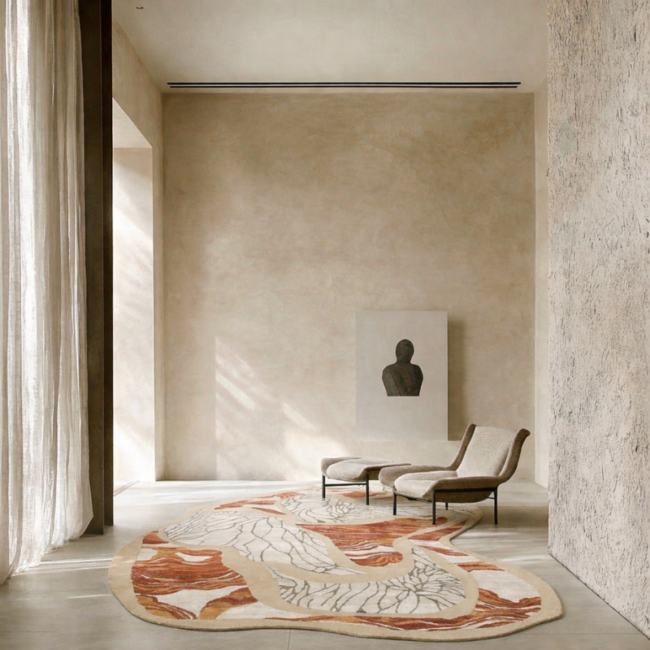
Rugs & Riches: Sustainability Built Into the Process, Not Bolted On
At Rugs & Riches, sustainability is not a separate initiative — it is embedded in how the company has operated for over 35 years. The dyeing process uses
environmentally responsible formulations developed and refined over decades. The workforce of 60 to 100 artisans works in documented employment conditions in our Panipat facility. And our material sourcing reflects a long-term commitment to quality that is, by definition, a commitment to durability over disposability. We welcome direct questions about our practices. Transparency is not a risk for us
— it is part of how we work.
Perfect mirror for you